Showing posts with label exhibition. Show all posts

works for disasters: an incomplete archive 2011-2021, Sally Ann McIntyre and Campbell Walker at Seventh Gallery

Works for disasters: an incomplete archive 2011-2021 was a collaborative exhibition by myself and Campbell Walker, presented at Seventh Gallery in Richmond, Naarm/Melbourne from 27 July - 18 August 2023. It was a suite of interlinked, previously exhibited works that all hinged on the theme of disaster and included three video/performance works, and two radio/transmission art pieces. 


My contribution to the exhibition involved a formal re-framing (and re-composing) of two ephemeral and temporal mini FM transmission works. Made a decade apart, these pieces converse together across time within the durational space of the exhibition, finding a shared focus on the ontology of transmission as a formal mode through which to attempt to grasp the wider slippage, liminality and material-structural changes of two disaster events. Ongoing questions come up for me when listening back to these works: how do we remember - or memorialise - traumatic events lived through, how to not reify them when attempting to grasp such intangible shifts? Can radio / transmission art modes work formally to mark these while honouring their ungraspability, to bring them into earshot, to frame them as an alternate archive of experience?

The first of the pieces is called a private swamp was where this tree grew feathers once: a radio memorial in four movements; it is from a set of works I was making in the late 2000s and early 2010s, when I first began operating the radio cegeste project, and was originally transmitted in January 2012. Alongside its companion pieces, modified radio memorial #1 (a fissure in the line of a public silence)After Bexley and dear friends who have died are all talking to me tonight / all at once, this work was an investigation of  radio/transmission art's formal capacity as a mediator for the archive and a potential site-specific mode, and an interventional spatial response to a particular set of transformative events: the seismic force of the many thousands of earthquakes that, starting in 2010, ruptured Ōtautahi Christchurch, New Zealand, forever altering the city's architectural and social fabric. Several of these works were exhibited together as "Selected Christchurch Radio Memorials" in the show Simulcast at The Audio Foundation March 7-30, 2013. All were radio cegeste transmissions (i.e. mobile, small-radius mini-FM) that re-distributed collections of field recordings as narrowcast transmissions, intervening into architectural spaces, approaching small-scale transmission itself as a mediator of and structural intervention into the poetic and political architecture of the airwaves, and as a creator of archives. 

'a private swamp.' was always the most private and ritualistic of these bounded re-castings. Functioning as a re-collection and re-transmission of the silences of four of my rented flats, some of which had been destroyed in the quakes, the transmission was not initially intended for a public outcome, and, remaining unrecorded, didn't really exist apart from the documentation (an essay and photographs) that anchored it in time as an event, and the set of four field recordings, each five minutes long, taken in the four flats, that were transmitted for the work. As such, the work for Seventh Gallery was re-composed from the fragmented remains of the 2011-12 transmission, much as that had been responding to the fragmented remains of the four houses themselves in 2011-12.

In the gallery I re-contextualised these recordings as a new transmission on the original frequency: radio cegeste's 104.5FM, alongside the essay I wrote about them, and several photographs taken of the site-specific transmission. The recordings could be tuned in within the space by anyone on their own device, although four small transistor radios also channelled the silences of the four flats. These were arranged in a small geometry, vaguely approximating a street map of the spaces themselves. One listener, on the opening night at Seventh Gallery, came up to me and said that he'd appreciated the "architectural" aspect of this arrangement within the transmission space of the four radios, as a conduit to the the way that the four rooms were entering another room in the present.

To re-visit this project now seems timely, if not conclusive. The quakes continue to reverberate through other life-events as a murmuring learning of site and substance that never seems quite complete, even as the topicality of media moves and forgets. Zita Joyce and Susan Ballard recently revisited the radio cegeste quake transmissions as a group in their 2022 essay "Seismic media: art and geological co-creation in Ōtautahi Christchurch, Aotearoa New Zealand," where they write of 'a private swamp’ and 'After Bexley': 

"Sally McIntyre’s radio work as Radio Cegeste 104.5FM hovers in this space of memory, briefly populating physical spaces with a spectral past. Her transmitter translates the acoustic energy of silent sites into electromagnetic energy, radio waves that are shifting and imperfect, difficult to receive clearly, prone to interference, like memory itself. Two of McIntyre’s works have particular resonance in the space opened up by the earthquake, as they use electromagnetic energy to displace, translate and reinterpret the sounds and silences of post-Quake Christchurch; a mediation of the after effects of the seismic. In the personal performance memorial ‘A private swamp / was where this tree grew feathers once’, McIntyre used a simple mini FM transmitter to record the interior spaces of houses she had previously lived in. The recordings were ritualistically framed, exercises in close listening, observing the movements of a building, its acoustic qualities and the silence beyond it. On the 2nd of January 2012, she transmitted the sounds of those houses all at once into one of them – one chosen because after 41 aftershocks in the preceding 24 hours it felt most stable. McIntyre described the work as a ritual of releasing layers of memory, ghosts and the remains of these spaces that once sheltered her, one of which had been reduced to rubble. The work was a radio memorial, a ‘mobile to hang invisibly in the air’, and a process of reclaiming the earthquake experience. McIntyre layered spaces and the times of memory and recording, into a single long meditative moment: a moment that was full of the anticipation of its own end – the fear that another wave of seismic energy would finally bring down the walls around her. (...) By bringing together memory, place and seismicity, these artworks both engage with the effects of the earthquake and respect its impact. They engage with histories of the city, integrating the past into the post-quake present and future. They also reflect the new geological expertise of living in a seismic city. Earthquakes have happened here before, but not in this way: able to be mediated by new technologies of recording, storage and transmission." 

I understand this period of radio cegeste's work as the systematic creation of a set of alternate archives: the recording as a library or index structure. Sean Cubitt writes of the archive that "in archive aesthetics we confront temporalities that extend backward and forward into times we experience both as sensory things here, now, in front of us, and also imaginatively as emissaries from the past to the future of which we form only one moment. To the extent that the aesthetic is also ethical (...) it ties us into networks of obligation which extend beyond the present moment into the deep past and the deep future."

Within such works and their small-scale reach, I was always trying to get to grips with the ways in which the durational nature of disasters within everyday lives sits in conflict with their role as spectacle within public media. The most obvious of these is the slow violence of climate change. But other disasters subtly announce themselves in ways that were also true of the 1600s plague and the 1918 flu epidemic. Even now, the Covid-19 pandemic that first emerged in 2020 is writing itself on bodies; both those that invisibly suffer from long covid, and those that walk the streets of inner city Melbourne, those in thrall to conspiratorial right wing mythologies, still protesting imaginary restrictions. As Joyce and Ballard go on to conclude of their investigations into creative works that have articulated a response to the earthquakes: 

Working with the earthquakes and their media has taught us much about the amount of time it takes for stories to emerge. This tracing of artists’ relationships with the material geology of a city points to new geological and aesthetic understandings. Media and experiences are still evolving, as houses and public spaces are still being rebuilt. Many of the evocative images of the Lisbon earthquake were published 100 years after the event. Media and image cycles are now much faster, and as we have shown, many creative responses to Christchurch were immediate and dynamic. Rather than considering media as a reflective material, we have suggested that seismic media is the result of co-creation between the elemental energies of the earthquake, the creative energies of the artists and the community and social energies of the city. 

Again, I return to Cubitt's thoughts on the archive, that it "is not an aesthetic category but an ethical one, in that we owe some obligation to the past and the future to maintain objects in the present. This obligation is either virtuous (it is right and fitting to recall the dead and pass on their memory) or deontological (we remember and transmit ancestral actions as we would wish ourselves and our works to be remembered and transmitted)." (Cubitt 2017) 

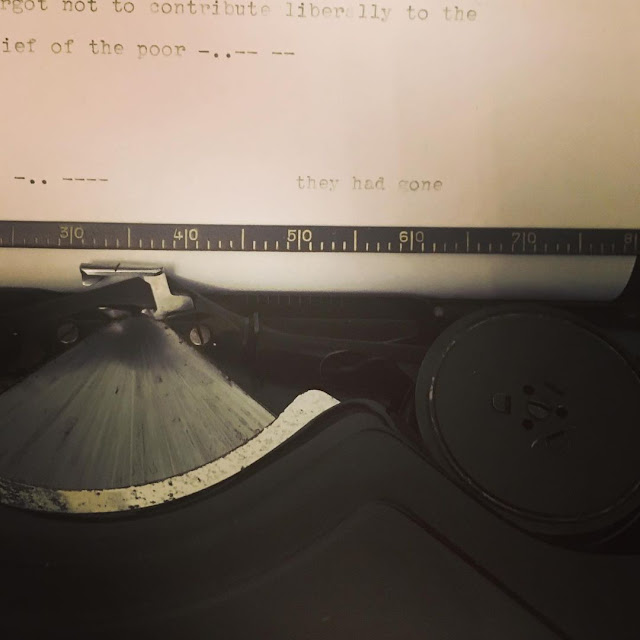
The second of my works in the show was '–. .-.. .- –. ..- . / -.– . .- .-. (plague year)' (2021) a fifteen part micro-cast radio serial narrowcasting a daily poetic reworking of Defoe’s A Journal of the Plague Year (1722), made during the pandemic lockdowns in Melbourne, as a commission for the State of Disaster public art project.


Post-extinction huia soundings, Te Whanganui-a-Tara 1912-1924 (moments of history torn away from the movement of history, then returned; no longer quite life, not yet death)


Post-extinction huia soundings, Te Whanganui-a-Tara 1912-1924  (moments of history torn away from the movement of history, then returned; no longer quite life, not yet death) is a sonic fieldwork project that extends and recontextualises ongoing artistic research by Sally Ann McIntyre that focuses on the audible traces of charismatic extinct bird the huia. In Collected huia notations (like shells on the shore where the sea of living memory has receded) (2015), two sets of early twentieth century musical notations of human imitations of huia calls were played on piano and then re-recorded on an extremely fragile and temporally bounded late 19th – early 20th century audio medium, the two minute phonographic wax cylinder. Post-extinction huia soundings geographically re-locates this media archaeological archive within a local map of sites where encounters with huia were documented in the Wellington Te Whanganui-a-Tara region after the species official extinction date of 1907. It takes the cylinders out into these sites, where they are played back repeatedly on a small Edison Gem phonograph until they erase themselves.

Rather than charting huia ‘sightings’ the work emphasises the central role of sound, recognising the long histories of more-than-human sonic interconnections between huia and humans in Aotearoa, developed over hundreds of years before the species was wiped out, and the further echoes of these histories in twentieth century cultural phenomena such as the use of huia song playback in 20th century bio-acoustic field conservation practices.  

In considering several unofficial huia sightings that were reported but not considered officially verifiable (such as a 1922 sighting in Lyall Bay that was dismissed by the then director of the Dominion Museum, who believed the species to be already extinct), the project focuses on the phenomenon of extinction debt, also known as “dead clade walking” (DCW), drawing parallels between the huia of the 1920s and extinction debt narratives in contemporary conservation, such as that attending the South Island kōkako.

Re-playing the archive of huia calls back into these post-extinction geographies creates an echo-chamber that opens the question of this extinct bird’s ongoing cultural life. It suggests that by the 1910s-20s the huia’s relationship to Aotearoa is already a hauntology that destabilises the early 20th century audible landscape of the settler imaginary with ‘the presence of an absence and the absence of a presence’ - or what Mark Fisher has termed the eerie - in ways that undermine empirical verification and visual representations. Instead, the huia’s histories and futures are bound up with oral culture recording methods that hear the human voice become a mediator to the absent presence of this most sacred of birds. “Soundings” might also be seen as a synonym for this interconnectedness, equated to kōrero, discussions, surveys, investigations, consultations.

Within this project, the phonographic wax cylinder is a time capsule traveling in both directions. It filters environmental and extinction histories through the functionality and temporality that is inscribed in the materiality of media technologies. It asks listeners to consider what can be gained by listening in an expanded way to the relations between what is inscribed within the materiality of media technologies, what is “recorded,” and what can never be.

----

Exhibition runs 24 June - 28 July 2023
Open Tuesday 10-4pm, at all Pyramid Club gigs and by appointment via email: admin[at]pyramidclub.org.nz
Special thanks to Creative New Zealand for supporting Pyramid Club's programme

The New Zealand Storm Petrel, transmission for 'Ground' exhibition, at Haus of Vovo


A work by radio cegeste is scheduled to be cast over the airwaves of a small-radius transmission art station embedded within Haus of Vovo, a project space in New Norfolk, lutruwita/Tasmania, in an exhibition entitled "Ground," opening next Saturday the 9th April and running until the 22nd May. It joins several other works gathered together on the theme of one of the four known fundamental forces of nature - electromagnetism.

My work "The New Zealand Storm Petrel" was originally released in December 2013 on the label Flaming Pines, within a series of small-run releases that saw sound artists focusing on particular species of birds. "The New Zealand Storm Petrel" is dedicated to its eponymous creature - a small, nocturnal, critically endangered pelagic bird endemic to Aotearoa New Zealand. It was thought to be extinct since 1850, and known only by a small number of museum study skins gathered by 19th Century collectors, until a series of sightings from 2003 indicated the presence of living birds and a previously unknown breeding colony.  

.--. .-.. .- --. ..- . / -.-- . .- .-. (plague year), for Radiophrenia Glasgow 2022


A new work by radio cegeste, '.--. .-.. .- --. ..- . / -.-- . .- .-. (plague year)' has been made as a half-hour program for radio art project station Radiophrenia Glasgow. It is scheduled for broadcast on 20 February 2022, 2:00 pm - 2:30 pm, GMT. 

'.--. .-.. .- --. ..- . / -.-- . .- .-. (plague year)' (2022) is a thirty minute edit of a fifteen part live transmission artwork that ran as a radio serial from 11-25 September 2021, as part of ROAD MAP: State of Disaster, a temporary public art project conducted within the bounds of a single geographic postcode, 3031, in Naarm/Melbourne, Australia, while the inhabitants of the city were under curfew, in the midst of the longest Covid-19 pandemic lockdown in the world. 


Microcast over local airwaves on the frequency 104.5FM, the serial was a daily poetic reworking of Daniel Defoe’s A Journal of the Plague Year (1722), written as 'a fictional reworking of true events,' a mock-first-hand account of the last epidemic of bubonic plague in London in 1665. 

TWIN SIGNALS AT SILVER STREAM (fragments of a landscape for specimens #50.766 & #50.767)


TWIN SIGNALS AT SILVER STREAM (FRAGMENTS OF A LANDSCAPE FOR SPECIMENS #50.766 & #50.767)

Drawing on the medium of radio’s ability to connect across time and distance, Twin signals at Silver Stream (fragments of a landscape for specimens #50.766 & #50.767) (2016-18) listens in to the global flows of colonial extractive economies via two minor silences present as traces in the landscape of contemporary Aotearoa/New Zealand. A new performance work and installation themed around erasure, the audible trace, extinction, colonial-era collecting, and silence, the piece utilises micro-radio transmission as a conduit for speculative forms of sonic repatriation.


Sceloglaux albifacies is an extinct New Zealand bird commonly known as the Whekau or Laughing Owl, once found nesting in rocky crevices in the remote landscapes of the South Island. In October 2016, one male (specimen #50.766) and one female (specimen #50.767) of this species were encountered in the Naturhistorisches Museum Wien (National Museum of Natural History, Vienna), as part of the collections of Andreas Reischek, an Austrian taxidermist and self-taught naturalist who spent over a decade roaming New Zealand in the late nineteenth century, appropriating an immense collection of ethnographic and natural history artefacts, including a near-complete set of New Zealand birds, the largest of its kind to ever travel to Europe. A local footnote within the totalising and globalising drives of Reischek’s taxonomic catalogue, the pair of owls were collected by the naturalist at Silver Stream, Otago, a small river near Mosgiel, in 1884, thirty years before the species was declared officially extinct.

"study for two unfinished silences (for Len Lye)" in Sensory Agents: Sounds of Len Lye Sculpture, at the Len Lye Centre, Govett-Brewster Art Gallery, New Plymouth, 4 Aug — 18 Nov 2018


In July 2018, in the Italian city of Prato, I found a small, antique zither in a local junk store. It was beautiful but in a sorry state. A few of its original 15 thin steel strings were missing, but those remaining had a pleasingly chiming, distinctly mournful sound. I procured it for 20 euro alongside its accompanying twelve yellowed, decaying music sheets that evoked the aesthetics of digital storage punch cards from an old computer, or player piano rolls. As the junk store owner demonstrated to me through our mutually shaky grasp of each others’ language, these triangular pieces of paper fitted under the strings to show finger positions, so even if a player wasn’t able to read music, they could still perform the songs in a kind of aural “paint by numbers.” It was an indicator of an era of folk-memory nudging up against the border of mechanisation, if not stepping over it into a literal "programmability," like a player piano. Most of the music sheets were popular Italian folk tunes. Just one was in English: the notation for the Christmas carol Silent Night.

Silent Night was composed by Franz Xaver Gruber, to lyrics by Joseph Mohr, in a small Austrian town in 1818, exactly 200 years before I bought the zither. In the subsequent two centuries, it has lost all its specificity, and travelled around the world to become a saccharine signifier of the global reach of Western culture and the commercialisation of Christmas. Might this have been one reason Len Lye chose to deconstruct it in his sculpture Roundhead (1961), a surprisingly delicate small kinetic whose material sound component is a toy music box, whose small mechanism once held this evocation of the hush of snow in a European December as its original crank tune? I suspect the carol's inclusion in the kinetic wasn’t as intentional as this, and Len used it because it belonged to one of his children, or he just happened to have it lying around the studio. Either way, during the work’s development, through processes of modification and removal of the music box’s pins by the artist, both the tune itself and all its cultural and narrative connotations were shaved down, broken, and fractured.

Roundhead (1961)in situ in the exhibition Len Lye: Stooped Short by Wonder, 
Christchurch Art Gallery Te Puna o Waiwhetū, September 2017
Lye’s use of silence and erasure in regard to re-sounding Silent Night within Roundhead was a witty and warm intervention whose delicate result belied a serious method. His use of a modified toy sound medium mirrored the use of the toy piano in the 1960s by artists to critique the significance of this most ubiquitous of instruments in European high-cultural music. For Lye it was also a piece of sonic inventiveness which echoed his discovery of direct film, as a creative leap born out of economic necessity. Both show his disinclination for repetition in media, over a generative and ever-evolving momentum that drew on the rhythms of the natural world. Lye’s inventiveness and DIY spirit, as well as his predilection for found objects mis-used for their creative potential, are currents very present in experimental arts cultures - including those in New Zealand - to this day.

study for two unfinished silences (for Len Lye) was commissioned by the Len Lye centre for the exhibition  Sensory Agents: Sounds of Len Lye Sculpture. The brief was an extraordinary one: to make a piece drawing on a sonic element of Lye's sculptural oeuvre. At the centre of study for two unfinished silences (for Len Lye) is a playing of Silent Night on the junk-store semi-programmable toy zither, captured in a one-take field recording in the room I was staying in for two nights in Prato, with busy street noise outside. Through arbitrary material damage (which parallels Lye’s more intentional erasure of the toy music box also originally programmed with Silent Night in the sculpture Roundhead), the tune itself has largely been erased through the missing strings of the damaged zither failing to register certain notes, as well as the limitations of the instrument providing their own tonal register, making this more ‘silence’ than ‘night,’ a music as rudimentary, aleatory and minimal as Lye’s broken music box.

This recording is then put into dialogue with another score, punched out on the simple paper strips of a programmable music box, that provides another layer of sonic material, which oscillates around the recording of the zither like the four rings of Lye’s sculpture, sometimes in harmony and sometimes in dissonance. This second sonic element is a phrase of musical notation written down in the field by a European listener to the song of a bird from Aotearoa / New Zealand, in 1913. Johannes C. Andersen, in his observational notes on the song of a particular tui in the vicinity of the city of Wellington, wrote: “one would suppose the bird to be “preparing” for singing, for he emitted more clicks, clacks, and gurrs than musical notes, sounding like the snapping and intermittent whirring of clockwork, as though his musical box had been undergoing seasonal repairs, and was being tested as to its mechanism.”

When Roundhead was made, it had already been a decade since Kenneth and Jean Bigwood had recorded and released the box set of 3 45 RPM records, A Treasury of New Zealand Bird Song, a set of recordings which would go on to become some of the most recognisable sounds on New Zealand radio. But it wouldn’t have been so easy for the expatriate Lye to listen to the sounds of his childhood in Aotearoa, even though I imagine he had tui lodged in his memory, whirring and clicking away. Maybe we’ve misunderstood Roundhead all these years: just as the tussocky sway of a kinetic like Grass evokes aspects of the New Zealand landscape, it would be just like Len to want to make a mechanical tui himself.

---

Exhibition
4 Aug — 18 Nov 2018
Centred around Len Lye’s noise-making kinetic sculpture and a set of audio recordings held in the Len Lye Foundation Archive, Sensory Agents focuses on the role sound plays in Lye’s work, and links Lye to a younger generation of artists who share his interest in the capacity of sound and music to elicit sensory responses.

Witnessing Lye’s steel sculpture in motion is a highly physical experience, with the sounds produced by their movements – their force, energy, rhythm and resonance – vital to their sensory impact and appeal. Working with steel, Lye developed a range of techniques to heighten the potential sound-producing qualities of his sculptures, including the use of bells and percussive ‘strikers’. This gave Lye the idea to record and make these new sounds available to musicians and composers as source material for their compositions, expanding their material for music.

In keeping with this idea, Sensory Agents also presents newly commissioned compositions by contemporary artists and composers using the sounds of Lye’s sculpture alongside original recordings held in the Len Lye Foundation Archive. It opens a new evaluation of his work in terms of sound and music, to consider them, in Lye’s own words, as ‘musical instruments rather than visual kinetic works of art’.


'Study for a data deficient species (grey ghost transmission)' at Audiograft Festival, Oxford, UK


Audiograft is an annual festival of Contemporary Experimental Music and Sound Art curated by the Sonic Art Research Unit (SARU) at Oxford Brookes University, U.K. This year's programme ran from the 6th - 18th March and included performances of new experimental music and sound, exhibitions, artists talks and workshops. I could unfortunately not attend, although I did have a piece travel without me, to be part of the group exhibition that anchored the festival, shown at OVADA gallery, alongside installations by Kathy Hinde, Sarah Hughes, and Simon Blackmore.

This was Study for a data deficient species (grey ghost transmission), which had evolved again through its previous installation iterations in exhibitions in Halle and Hobart, and the broadcast of a piece in the programming of Glasgow's Radiophrenia, toward an indexical simplicity. No live transmission in this iteration, but a more minimal presentation that predicated an emphasis on the catalogue, the sound object, and the listening experience as a recording with fixed duration. 
Thanks to Patrick Farmer, and all at Audiograft. images by Paul Capewell + SARU.

radio 33, broadcasting from Domain House, Hobart, as part of the Hobiennale, 3-12 November, 2017.

When operated in politically strategic ways, the contemporary aesthetic use of modernist technologies, like radio, can function as an effective localised antidote to a global technological homogeneity, one that ultimately flattens the field to a narrow bandwidth of expressive possibilities, within a homogenised focus on commercial interests.

Joining other experimental and artist-run stations I know which are using the constraints of bounded technological space to critically address this set of conditions, is a small North Hobart micro-cast radio project called Radio 33, which specifically re-imagines radio, through the operation of month-long artist projects put into physical broadcast space as small scale, low power FM transmissions, as a potentially emancipatory medium, where communities can be built and the like-minded can connect with each other.


Radio 33's particular take on the minor and amateur literature of the airwaves is historicised within its careful listening to gendered histories of radio space, hearing them - and celebrating them - as a medium holding an ongoing structural continuum of self-identified female/non-binary voices audible since the medium's earliest days.

With core reference to the U.S. radio amateur/ham designation YL, instituted in 1920 by the American Radio League to designate a female operator, and amateur operator Clara Reger's subsequent YL33 code, coined especially for women communicating with other women, a salutation "considered sacred by female hams", Radio 33 recognises these historic women as kin and forebears, as well as the ongoing work it has taken, in the past and the present, for such voices to claim audible space, as - and for - themselves.

Tricky Walsh, the artist behind Radio 33, has been experimenting with the artistic use of radio in their work since 2011, and started this project at the beginning of 2017 as a radio station programmed as a gallery space for month-long artist projects: "I see it as less of a "program" than a virtual space anyone could 'walk' into and experience a sound work. just think of it as a gallery space made out of radio waves".

I was lucky enough to be invited by Tricky to be one of four 'ephemeral residents' in this on-air gallery space for the duration of the inaugural Hobiennale Arts Festival, from 3-12 November, in the beautiful upstairs attic rooms of Domain House in Hobart. Radio 33 broadcast a compilation of my extant past and present sound and radio art works into this listening space, and after this first excursion into the possibilities, I very much look forward to developing new work for - and with - Radio 33 in the near future. 

thanks to Tricky, also, for the photographs and the text.

'Das Große Rauschen: the Metamorphosis of Radio' at Radio Revolten Zentrale, Halle.


arriving in Germany to be resident for the month of October in the city of Halle (Saale) to participate in the Radio Revolten International Radio Art Festival, I am joining more than 70 artists from 17 countries who will visit this month to contribute in a variety of ways to the festival, at the invitation of artistic director Knut Aufermann, and co-curators Anna Friz, Sarah Washington, Ralf Wendt and Elisabeth Zimmermann. That’s 30 non-stop, exciting and exhausting days of contemporary radio art, at 15 locations around this small and picturesque city, in the form of performances, site-specific installations, concerts and events, and live radio broadcasts, as well as discussions in the upcoming symposium Radio Space is the Place. The festival will be transmitting 24 hours a day on Radio Revolten Radio, on the FM frequency 99.3 MHz in Halle, further afield locally on the AM (middlewave) frequency 1575 kHz, and reaching a worldwide audience via the festival livestream. Additionally, 35 radio stations around the world will integrate parts of Radio Revolten Radio into their own programming, including Resonance FM, Radio Zero, Wave Farm/WGXC Hudson Valley NY, and other stations involved in the Radia network, whose members will also take the opportunity to converge for a two-day meeting and thinktank at the studios of Halle's Radio Corax during the festival.

A week out from the opening, I am currently setting up my installation within the walls of room 106, once the office of a certain Frau Dieter, on the first floor of Radio Revolten Central in Rathausstraße 4, for the contemporary art exhibit Das Grosse Rauschen: The Metamorphosis of Radio (2nd–30th October 2016), which also features Steve Bates (ca/qc), DinahBird and Jean-Philippe Renoult (fr), Golo Föllmer and friends (de), Fernando Godoy M and Rodrigo Ríos Zunino (cl), Jeff Kolar (us), Emmanuel Madan (ca/qc), Kristen Roos (ca), with Maia Urstad (no) installed in the Stadtmuseum Halle as part of the “Unsichtbar Welle” historical installation. The curator of Das Grosse Rauschen, Anna Friz describes the exhibition as grouping “international artists working on the cutting edge of art with a trailing edge technology,” focusing on the expanded context of radio art: “What other possibilities might exist for radio in the popular imagination, what significance might radio have outside of it’s usual functions of broadcasting information and entertainment? Artists working with radio have consistently sought to re-imagine the medium itself: to subvert the standardized and institutional approaches to broadcasting, to challenge ownership (state or corporate) of the airwaves, to rethink what counts as transmission infrastructure by pulling radio out of the studio and into new spaces for public actions, installations, performances, infiltrations, and interferences.”

My contribution to this exhibition is threefold, with an interconnected suite of works exploring the indeterminacies of historical memory via the medium of transmission: site-specific iterations of Collected Silences for Lord Rothschild and modified radio memorial (a fissure in the line of a public silence) will be joined by a new work, study for a data-deficient species (grey ghost transmission). More detail follows:

tidelines for water street

a site-specific installation of a durational score created for the independent artist-run exhibition in a blessed parenthesis, in a vacuum full of promise, located in a warehouse at 57 crawford street (cnr. jetty street, above dutybound bookbinders), central Dunedin, NZ, November 2015. included a performance event and artist talk in which the score was activated (as "hundreds of simultaneous shorelines"). premiere performers were Motoko Kikkawa (violin), Campbell Walker (shortwave radio), and myself (mini FM transmitter, receivers, zither.)
--- x ---


title: tidelines for water street 
date: 24 Nov – 1 Dec 2015
time: various
notes: a sound score is constructed from a Dunedin street, using the location. In its initial stages, this score is a textual response to the idea of “land reclamation” and the fact that this street is on a part of the earth that was, until recently, underwater. It progresses further into the investigation of tidelines from various eras between the 1840s and 1890s, which inched forward from the place used as a landing site by Maori who were embarking on mahinga kai expeditions at the time of colonial settlement, which under the name Toitu Tauraka Waka became the first site in the South Island, and second nationally, recently recognised as a wahi tupuna (an important place of Maori ancestral significance).

The tauraka waka site was gradually swallowed by building and foreshore reclamation as the settlers threw more and more stuff into the harbour, including whole inconvenient parts of the landscape and later, the built environment; both were treated as raw material for what we might identify as, geologically speaking, an anthropocenic armature, a conglomerate “archaeological” landmass that everyone could contribute to: geological cross sections might reveal not just monumental or ‘natural’ things but strata of broken tea cups, glass bottles, and garden wastage. 

Collected Huia Notations (like shells on the shore when the sea of living memory has receded)


Collected Huia Notations (like shells on the shore when the sea of living memory has receded) is a work for phonograph, solo piano, and extinct bird. It collates the four known Western musical notations of the song of the Huia (Heteralocha acutirostris), an endemic New Zealand wattlebird of the ancient family Callaeidae, which was driven to extinction in the last decades of the Nineteenth Century, partially through the attentions of overzealous wealthy Victorian Ornithologists and Museum collectors.


notes toward a library of superlative trees. a transmission for Eucalyptus regnans

notes toward a library of superlative trees. a transmission for Eucalyptus regnans was one of two works exhibited as part of a listening air. / They are that that talks of going at Constance ARI, Hobart, Tasmania, which opened on 10th January 2015, alongside works by Matt Warren and Alex Bishop-Thorpe. It was part of the offsite programme for the sound festival Mona Foma.  

the work is a mini-FM radio programme which conducts radio art as a form of fieldwork. It investigates the notion of non-human memory through engagement with the sounds of the tallest flowering plant in the world, a tree native to Tasmania and Victoria, but now found worldwide. 
Orokonui eco-sanctuary in Dunedin, New Zealand, is a biosecure reserve for rare New Zealand birds. It also contains “New Zealand’s tallest tree”, a Eucalyptus regnans and an introduced Australian, planted in the 1870s as part of a farmland boundary line. 

the unavailable memory of gold coin cafe / lee song & co.

When Wellington artist Kerry Ann Lee invited me to contribute to The Unavailable Memory of Gold Coin Cafe, a project she initiated around the site of the Yeung Sheng Restaurant, previously the Gold Coin Cafe, in Willis St.,Wellington, we'd already had quite a lively discourse around its themes.                                                              Kerry Ann is a Wellington artist of NZ/Chinese descent, and for her, the Gold Coin Cafe was more than a fondly remembered local landmark of cheap late night eats, it was a place she grew up in, playing and doing her homework out the back of the Chinese restaurant and takeaway her parents ran as a family business throughout her childhood. Earmaked for demolition due to the new earthquake-strengthening laws post 2011, Kerry Ann was personally confronted with the prospect of the material erasure of the site of these memories.  

'Nature Reserves', group exhibition at GV Art, London


Two works themed around erasure, the audible trace, extinction, colonial-era collecting, and silence, Huia Transcriptions and Collected Silences for Lord Rothschild were aptly included in a group exhibition, titled Nature Reserves, which ran at London art/science gallery space GV Art from the 26th july - 13th september.

'selected radio memorials'


a suite of transmission works collected from the last few years' somewhat consistent low-level preoccupation with narrowcast radio and local seismic activity are to be included in Simulcast, a group exhibition of radio works running at the Audio Foundation's Auckland space from the 7th - 30th of March, also including work by Auckland artists Ivan Masic and Jay Hollows, and a 'radio wormhole' linking Auckland to central Christchurch, a sonic transfer of the everydayness of each locale opened up for the month's duration by Zita Joyce.

Radio d’Oiseaux : attempts at the non-linearity of a nest 1 & 2 at the Blue Oyster Gallery, Dunedin


'attempts at the non linearity of a nest' comprised two works. both were exhibited as part of the group show Media Povera, at the Blue Oyster Gallery, Dunedin, 13 July - 7 August, 2010.

'attempts at the non linearity of a nest #1' was a live sound piece recorded in the office of the Blue Oyster gallery, direct from radio transmitter to the gallery’s telephone answering machine, to be heard only by callers to the gallery when no-one was present to pick up the phone, and erased without being recorded anywhere else, at the conclusion of the show. this work comprised me re-vocalising the only extant recording of a Huia (Heteralocha acutirostris), the original sound recording of which is itself not a recording of the actual bird, which became extinct before sound recording technologies were widely available, but a human imitation of the bird (or, if you like, a playback by an organic/mnemonic recording device) by a Maori guide who remembered the song from his childhood. I also recorded myself singing and playing on the violin The Huia Song (a Maori Lament), a NZ popular song written by O. M. Shakespeare in 1932. Playing these recordings back in a live performative manner through the Radio Cegeste transmitter, direct to the blank 'audience' of the gallery telephone, the recordings were fragmented and augmented by the naturally occurring electromagnetic and radiophonic noise to be found in the space, to produce a soundscape that seemed lost in time, evocatively filtered by traces of other signals, erasure, and interference.

'Nesting' this work in the gallery's telephone re-imagined the 'phone - normally a pragmatic, humdrum part of the gallery operations, an invisible sonic conduit of its office - as a small gallery space, the work's housing of itself in a part of the Blue Oyster's 'corpus' not normally open to artworks had a slightly parasitic quality which drew out the 'cuckoo' thematic of the work. It also opened up the real-time poetics of the telephonic space. In a time when 'land lines' are becoming less common as they are replaced by wireless communication devices, we arguably have just as much opportunity to reflect on the materiality and usage of older telecommunications technologies as we do newer ones (a situation which is mirrored by the situation of radio : I was not tempted here, for example, to make this work as an application for iPhone, in the same way as I prefer to use a home-soldered analogue Mini FM transmitter rather than make a digital podcast radio show), as a framework with potential to re-invest itself with imaginative or artistic possibility, retro-fitting the intimation of wonder that Marcel Proust (who himself used to listen to opera and theatre live from Paris over the 'phone) described as waning so quickly in the early 20th Century, when he wrote about the telephone in 1907 as "a supernatural instrument before whose miracle we used to stand amazed, and which we now employ without giving it a thought, to summon our tailor or to order an ice cream." In the development of this work, where two older communications technologies set up a listener-speaker relationship, I was also reminded of an interview with Peter Jefferies in which the musician talks about artistic inspiration as a 'tuning in' to possibility : "The last line on the last song on the "Last Great Challenge in a Dull World" goes, "I'm a tape recorder talking to a telephone line, listening." He continues : "I don't know where the songs come from. They come from somewhere. I don't feel that I write them per se. I feel like a radio set who just happens to be tuned in some kind of of way that I pick this stuff up." I didn't know where the songs came from either, suffice to say that the after-hours caller to the Blue Oyster for the duration of the exhibition Media Povera might be lucky enough to hear, instead of the usual message detailing the gallery's hours and the show's title and duration, a supernatural answering machine message transmitted from an extinct bird.


The Huia Song
A Maori Lament

The pohutukawa trees,
Wave on the morning breeze,
The bellbird is carolling,
The wild duck is on the wing,
But you, but you have gone!

Ah! see how the silver fern,
And once laughing waters yearn,
And there 'neath the skies soft blue,
Tui notes they faulter too,
Pining, pining for you!

Sacred Huia, none can trace,
Your far distant dwelling place,
Kauri trees night watches keep,
We can only grieve and weep,
Seeking, seeking in vain!

Te Pohutakawa e
E mihia nei e te matangi
Koe komako e hotu nei
Koe parera, e tangi ra
Mo huia ka ngaro nei

Nga wao o Tane tenei
Nga uri o Tangaroa
O taina me te iwi
Kei te koingo ki a koe e
Huia ka ngaro nei koe

E te manu tapu nui
E te kura rangatira
Kei hea koe e kimihia nei
E tangihia nei e matou E Huia hoki mai ra.


'attempts at the non linearity of a nest #2' had, in contrast, a physical presence in the gallery space, but contained its own set of gaps and erasures, mainly based around ideas of the found object, memory, recording technologies, representations of nature, and the post-Victorian technologised paranormal. The work comprised a found bird’s nest - which I chanced upon one day lying in the middle of a path in the Christchurch Botanical Gardens and had kept ever since - containing an unwound spool of magnetic audio tape, a response to specimens of nests I had recently seen in the endemic ornithology collections of the Museum of New Zealand Te Papa Tongarewa, in particular a nest which seemed to be lined with a shiny brown material which, as the curator of birds pointed out to me, looked remarkably like audio tape. Fascinated, I recorded the sound of this empty nest in a subsequent visit in the back-room storage areas of the ornithological collection of the Museum using the Paranormal Research method of Electronic Voice Phenomenon (EVP), then transferred it to blank audio tape, and placed the audio tape in the Botanical Gardens nest. The Mise en Abyme aspect of this work seemed to hint at an infinite regress of emptinesses, a 'cuckoo' of blank potential around which the 'host' nest and its silence wound a careful cradle of tiny, perfectly arranged sticks and moss, lined with soft feathers.

future plans are to place this (currently unplayed) audio tape, still in its nest, outdoors in a tree, for a set period of time, and subsequently make a work ('attempts at the non-linearity of a nest #3') with the results, whatever the condition of the unspooled, and as such sensitive and brittle, tape (exposed to the elements, decayed, or missing). i figure this proposed aleatory experiment in exposed natural-material sound, whose material has additional status as a EVP recording, might potentially result in a complex imprinting of myriad traces, becoming a potential reversal of the moment of technological/spiritual encounter by Swedish painter, archaeologist and former opera singer Friedrich Jurgensen on June 12, 1959, when visiting his country house one summer.

Jurgensen brought along his tape recorder, to record the singing of wild birds (especially the chaffinch, of which he was evidently quite fond). Later when listening back to the tape he "heard a wild noise, vibrating like a storm, where you could only remotely hear the chirping of the birds. My first thought was that maybe some of the tubes had been damaged. In spite of this I switched on the machine again and let the tape roll. Again I heard this peculiar noise and the distant chirping. Then I heard a trumpet solo, a kind of signal for attention. Stunned I continued to listen when suddenly a man's voice began to speak in Norwegian. Even though the voice was quite low I could clearly hear and understand the words. The man spoke about 'nightly bird voices' and I percieved a row of piping, splashing and rattling sounds. Suddenly the choir of birds and the vibrating noise stopped. In the next moment the chirping of a chaffinch was heard and you could hear the tits singing at a distance - the machine worked perfectly!"

Jurgensen continued after this incident to investigate the phenomenon, which he came to believe was "from the other side", i.e. the voices he was recording were the voices of the dead. Over the years, he made thousands of recordings of these voices, ranging from his family and friends to, more strikingly, people such as Vincent Van Gogh and Himmler's masseur. Jurgensen believed he heard the voice of his dead mother on one such tape, an experience he described as life-changing : "I was outside with a tape recorder, recording bird songs. When I listen through the tape, a voice was heard to say "Friedel, can you hear me. It's mammy..." It was my dead mother's voice. 'Friedel' was her special nickname for me."

The recordings in Jurgensen's archive are claimed to be the world's first recordings of Electronic Voice Phenomena (EVP), the paranormal appearance of strange voices on magnetic tape. In this he was very close to earlier inventors and users of technologies of transmission : both Guglielmo Marconi and Thomas Edison believed in the possibility of using new recording devices to contact the dead, and Sir William Crooks, President of the Royal Society and inventor of the cathode ray tube, and Sir Oliver Lodge, one of the leading contributors to radio technology, believed the other world to be a wavelength into which we pass when we die.

The questions I often ask when thinking of Jurgenson's experiments are many : was the recording of his mother really just an imperfectly erased recording from former times? Does that still mean it was a transmission from the other side of the reproductive-technological time divide, anyway? And : how did he know that the birds he was listening to were not voices of the dead, as well? While I think about this further, the recorded silence of an empty nest will at some point take its chances in my garden, perhaps in the coming spring, where I am hoping some live birds might be encouraged to interact with it, too.

Until then the last word on the subject of nests goes to Gaston Bachelard. In chapter 4 of his book 'The Poetics of Space', he writes, "A beginning of a philosophical phenomenology of nests would consist in our being able to elucidate the interest with which we look through an album containing reproductions of nests, or, even more positively, in our capacity to recapture the naive wonder we used to feel when we found a nest. This wonder is lasting, and today when we discover a nest it takes us back to our childhood or, rather, to a childhood; to the childhoods we should have had. For not many of us have been endowed by life with the full measure of its cosmic implications."


'SiB (sounds-in-between) Radio Gowanus' - narrowcast radio project at Cabinet Magazine gallery, Brooklyn


When radio cegeste was invited by free103point9-associated, US-based curator Maria Papadomanolaki to participate in her narrowcast installation project SiB (sounds-in-between) Radio Gowanus, a radio station operating from 16-19 March as a component of the exhibition Postcards from Gowanus (at Cabinet Magazine's gallery space, Brooklyn), mail-art was on my mind. As was considering the near-obsolete medium of the postcard, from the perspective of the history of distance-based communications and its associated media and artforms, as being less an object than a postal circuit, with conceptual links to other communicative mediums (eg. narrowcast radio, the internet), with a focus on its similar potential for one-to-one relationships between transmitter and receiver within networks of exchange. As John Held writes, in his historical analysis of mail-art in Annemarie Chandler and Norie Neumark's At A Distance : Precursors To Art and Activism on the Internet : "...the Mail Art community... was fixated not on the postal exchange, but rather on the aesthetics and distribution of communication".

As a sometime collector of haunted sounds and haunted images, my starting point in looking at postcards as communicative devices was to ignore any monumental, touristic or nationalistic aspects, the glossy, mass-produced surfaces, and turn to the flipsides, the 'b-sides', if you will, of this media, the scrawled notes and memos of which are not spaces of public, shared, already-agreed-upon meaning. (Re)reading the lost, potentially long dead messages of a collection of randomly selected postcards from the first half of last century as a form of broadcast, I searched through their voices as a way of activating the wider medium's poetics of the personal. This process was greatly helped, practically speaking, by my amateur-collector's interest in vernacular postcard photography and the micro production-scale of the Real Photo Postcard (RPPC), a form of community driven, folk-photographic exchange of small runs of images, which New York based writer Luc Sante refers to as a "ghost telegraph".

As Sante puts it in his recently published Folk Photography : The American Real Photo Postcard 1905-1930 : "The real-photo card was typically a product of the small town, particularly the small town isolated on the plains, whose newspaper did not have the capacity to reproduce half-tones, and whose lonely citizens felt an urgent need to communicate with absent friends, distant in those days even if they lived only three stops down the railroad line."

A second aspect to the project's development was also to consider the notion of a 'sonic postcard' in an entirely more literal and formal sense, by looking at the 78RPM phonographic postcard, a truly odd and fascinating footnote in the history of audio-visual media, briefly in existence in the early 20th Century. Some images can be found above, and here is their place within a timeline of sonic media on the Museum of Technology site. These sometimes twee, often awkward, highly ephemeral hybrid objects are spatially and temporally bounded transmitting devices, with their messages constrained to 'postcard size' spaces; they are also notable for the way their production and dissemination through postal networks exposes a shift in the cultural function of sound recording and playback media, in the early stages of their popular usage, from agency- or user-driven toward something more passive and receptive, with the audio component of these home-recorded, directly communicative 'real phono postcards' (as they were, early on, carrying messages from speaker to speaker, like an audio telegraph, or an answerphone message, before becoming a more symbolic transfer, via the transmission of a novelty pop jingle); tracing a similar process as can be seen contemporarily, perhaps, in the difference between sending a personalised email and an online social networking mass gesture, in the form's evolving from one-to-one communicative device toward its later standardisation and commodification of communication.

The brief lifespan of this hybrid medium is traced in an online history of Tucks 'talking postcards', which can be found here. It's interesting in particular to note the shift from Max Thomas's conception of their usage...

"On October 7th 1904 Max Thomas, manufacturer of phonographic machinery and requisites at Berlin, claimed a patent for Phonogram Cards, for which he also applied in the United Kingdom in August 1905: "It has been proposed to enable persons, each provided with a gramophone, to converse one with the other by sending through the post a postcard or lettercard composed of paper or celluloid which has been previously impressed by the recording device of the sender's instrument..."

... toward the highly successful, and slightly suspect, popularising of the short-lived medium by the Tuck company :

"Judging by the numbers of cards still turning up at flea markets, the only company that succeeded in manfacturing Gramophone Record Postcards commercially in large amounts seems to have been Raphael Tuck. The Raphael Tuck Company published their first Christmas greeting card in 1871, and the first picture postcard in 1894. The Tuck Company entered the American postcard market in 1900 and maintained an office in New York. American artists designed the postcards and they were printed in Germany and England and returned to the U.S. for sale. In 1929 Tuck went into the business of producing Gramophone Record Postcards. As all kinds of postcard designs (landscape view, greeting cards, art reproductions) turn up, and the pictures are largely obscured by the dark-brown opaque recording material, it is thus probably safe to assume that Tuck used obsolete old postcard stock as raw material for their product. The cards do look much older than 1929, and the designs hardly ever have any logical relation to the (electrically) recorded sound pasted upon them. Any recording could be pasted on any postcard – and, discographically speaking, noting details of the postcard designs would be irrelevant. The musical selections are exclusively public domain, no money was spent on music rights and royalties.[...] In the absence of recording ledgers or other factual evidence, it is difficult to identify the performers and to date the performances. The repertoire mostly consists of undateable standard repertoire pieces - folksongs, Christmas carols, marches, spoken greetings etc. No doubt this helped Tuck to avoid paying royalties"

The relation of the phonographic postcards to certain concerns in contemporary media art practices is an intriguing one. In a way, Tuck's clunky, imperfect, oddly charming, failed-acousmatic layering of a sonic communicative medium onto a visual one is formally, if accidently, in alignment with the strategies of 'SIB Radio Gowanus' itself, if this email description from curator Maria, of the non-synchronous layering process of spectatorship around the radiophonic / visual elements of the show, emphasising the slippage and gaps between media, and distance between participants, is anything to go by :

"They way it will be set up is as follows: Signal goes into the transmitter and then visitors will be given radio headsets to tune in as the wander around the gallery. Many of the exhibits have a very prominent visual aspect so I am pretty sure that this very intimate second layer of sounds will create interesting correlations. Apart from the imagined soundscapes sent by the translocal participants, the program will also feature field-recordings and sonic artworks produced using the local sonotopia."

As yet another broadcast project involving participation via casting over networked distance, this time not with the associated immediacy of live streaming, but instead through posting recorded audio through the internet file sharing service 'sendspace', to a gallery-based localised transmission on the other side of the world, i took the project, inevitably, as an opportunity to self-reflexively explore the poignant relation New Zealanders have to communicative distance, and the associated history of media within NZ culture. A focus on nostalgia and folk-related forms perhaps digs deeper into the networked surface, underlining that the 'translocal' nature of such contributions mostly works best when it doesn't elide the exploration of a specificity of location (or the history of that specificity) in its drive toward the 'transnational'.

I'm looking forward to the feedback, from a distance.

----

this is what the organisers had to say, generally, about the show (from the blog, readable here) :

“Postcards from Gowanus” is a creative research program exploring a multitude of approaches to mapping the immediate vicinity surrounding Cabinet Magazine’s gallery space in Gowanus, Brooklyn. Drawing upon the psychogeographic tradition of critically and creatively engaging with public urban space, “Postcards from Gowanus” will examine the ways that mediation fundamentally alters our relationships to the environments in which we conduct our daily lives.

"Sib (Sounds-in-between) Radio Gowanus" is a narrowcast audio exhibit that will run in conjunction with the exhibition "Postcards from Gowanus". The program will host a series of sonic artworks ranging from field recordings, drones, micro-sound to ambient and electro-acoustic compositions by US and International artists, including works by the participants of the "Postcards from Gowanus" exhibition.

"Sib Radio Gowanus" essentially bridges the space between the inaudible, invisible (and yet real) ethereal and the physically present exhibits inside the gallery.

"Sib Radio Gowanus" is curated by Maria Papadomanolaki and is sponsored by free103point9. Participant Artists (so far): Tim Arndt, Giancarlo Bracchi, Peter Cusack, Penny Duff, Gabrielle Herbst, Amir Husac, Lina Lapelyte, Daniel Lopatin, manekinekod, Sally Ann McIntyre, murmer, Michelle Nagai, Naono, Dimitris Papadatos, Maria Papadomanolaki, Heidi Prevost & David Smith, Jase Rex, John Roach, Sawako, Janek Schaeffer, Jeremy D. Slater, Hans Tammen, Mark Peter Wright, Bryan Zimmerman.