Showing posts with label environmental radio. Show all posts

TWIN SIGNALS AT SILVER STREAM (fragments of a landscape for specimens #50.766 & #50.767)


TWIN SIGNALS AT SILVER STREAM (FRAGMENTS OF A LANDSCAPE FOR SPECIMENS #50.766 & #50.767)

Drawing on the medium of radio’s ability to connect across time and distance, Twin signals at Silver Stream (fragments of a landscape for specimens #50.766 & #50.767) (2016-18) listens in to the global flows of colonial extractive economies via two minor silences present as traces in the landscape of contemporary Aotearoa/New Zealand. A new performance work and installation themed around erasure, the audible trace, extinction, colonial-era collecting, and silence, the piece utilises micro-radio transmission as a conduit for speculative forms of sonic repatriation.


Sceloglaux albifacies is an extinct New Zealand bird commonly known as the Whekau or Laughing Owl, once found nesting in rocky crevices in the remote landscapes of the South Island. In October 2016, one male (specimen #50.766) and one female (specimen #50.767) of this species were encountered in the Naturhistorisches Museum Wien (National Museum of Natural History, Vienna), as part of the collections of Andreas Reischek, an Austrian taxidermist and self-taught naturalist who spent over a decade roaming New Zealand in the late nineteenth century, appropriating an immense collection of ethnographic and natural history artefacts, including a near-complete set of New Zealand birds, the largest of its kind to ever travel to Europe. A local footnote within the totalising and globalising drives of Reischek’s taxonomic catalogue, the pair of owls were collected by the naturalist at Silver Stream, Otago, a small river near Mosgiel, in 1884, thirty years before the species was declared officially extinct.

'three variations on a study for a data deficient species (grey ghost transmission)' on air at Radiophrenia 87.9FM, Glasgow


I have a radio art piece included in the impressively extensive schedule of radiophonic experiment coming up in the programming of radiophrenia 2017, a temporary project station for radio art, broadcasting 24 hours a day from 6 - 19 November, out of Glasgow’s Centre for Contemporary Arts. This solid fortnight of radio, sound, and transmission art (from friends, peers and many new names), together promises to "promote radio as an art form, encouraging challenging and radical new approaches to the medium."

'dead silence: ecological silencing and environmentally engaged sound art' : paper by Dugal McKinnon, at New Zealand School of Music, Wellington


Dr. Dugal McKinnon of the New Zealand School of Music gave this talk at the Adam Concert Room in Wellington today, about silence in ecologically minded sound work, in which he discussed two works I made during my Kapiti Island residency, Collected Silences for Lord Rothschild, and Huia Transcriptions.

More of Dugal's writing can be read on his blog here.

'the transit of venus, study for shortwave #1' included in Air / Ear: Radio & Nature, Argentina

"Air / Ear" was a transmitted installation of the work of 37 radio and sound artists into a cultural hall of a small town, San Justo, Santa Fe, in rural Argentina. The project was curated by Ruben Marino Tolosa.

the work I contributed, 'the transit of venus (study for shortwave 1)', was recorded in a blustery field on a miserable day on kapiti island, and it was played into the space on the 13th July 2012.

'gull lines, at a slope of conduction (for waiorua shoreline, violin and shortwave)' in TIK festival of ecological media arts, Brussels


gull lines, at a slope of conduction (for waiorua shoreline, violin and shortwave) was recorded during early May on Kapiti, as a contribution to the Time Inventors Kabinet (TIK) festival of ecological media arts (11 - 13 May 2012) in Brussels. It emerges from my current research into the area of Kapiti Island, supported by Creative New Zealand and the New Zealand Department of Conservation.

Both as a contribution to this festival and within the wider parameters of my current project, the piece extends the sounds of a remote place to listeners in the heart of an urban sphere across the other side of the world, taking as part-provocation R. Murray Schafer and Bruce Davis's concept for a 'wilderness radio' : “the plan was to put microphones in remote locations uninhabited by humans and to broadcast whatever might be happening out there; the sounds of wind and rain, the cries of birds and animals – all the uneventful events of the natural soundscape transmitted without editing into the hearts of the cities. It seemed to us that since man has been pumping his affairs into the natural soundscape, a little natural wisdom might be a useful antidote”. (R Murray Schafer, 'Radical Radio' in 'Sound by Artists', ed. D. Lander & M. Lexier, 1990)

(It should of course be pointed out that Kapiti is in fact inhabited, albeit sparsely, as many such places are).

'Garden Aria / a Library for the Birds of Ōtepoti' on TIK (TimeInventorsKabinet) ArtRadio, Bratislava, Slovakia


this small-scale live transmission work was performed, collected and re-transmitted by Radio Cegeste in the private gardens of an historic mansion in New Zealand's oldest city, Dunedin, over the course of one day in early spring, the 11th September 2011. Comprising site specific outdoor raw field recordings of improvisational acoustic violin and portable crank Gramophone playback of a 78rpm record of birdsong by Beatrice Harrison ('Dawn in an Old World Garden (English Songbirds Awakening) / Nightingales, Actually recorded in Beatrice Harrison's Garden, Oxted, England', Orthophonic Recording, Victor 20968), as well as live solar-powered transmission of environmental recordings collected during the day, progressively layered back into the environment via solar powered Mini-FM transmitter and radio receivers.


'transfiguration for winter light and folded time' narrowcast at Rice & Beans


"....my body [for example] lives in as many spaces as the society, the group or the collectivity have formed; the Euclidian house, the street and its network, the open and closed garden, the church or the enclosed spaces of the sacred, the school and its spatial varieties containing fixed points, and the complex ensemble of flow-charts, those of language, of the factory, of the family of the political party and so forth."

"...all times converge in this temporary knot: the drift of entropy or the irreversible thermal flow, wear and ageing, the exhaustion of initial redundancy, time which turns back on feedback rings or the quasi-stability of eddies...."
-Michel Serres

a radio programme transmitted at midday on monday 30th May, transfiguration for winter light and folded time was staged for one hour as a audio contribution to the exhibition Money We Can't Use Here, by Japanese-Dunedin artist Motoko Kikkawa.

Motoko's show, currently enjoying its first week of slow material accumulation at recently established Dunedin artist-run space Rice and Beans, comprises an artist book, delicate sculptural works (an exquisite Elizabethan collar made of short-grain rice that references paper cutting), digital prints, and various performative interventions. Sparse and waywardly tuned, the show foregrounds the space's quietness and light in this final (pre)wintry week of May, with live works involving various performers inhabiting the space, often populating it briefly with sonic interventions. These performative inhabitations and nomadisms have included guestings by Matthew Ward and Richard Scowen, as well as the occasional appearance by Kikkawa herself on violin.

The formal structure for transfiguration for winter light and folded time involved temporal mirroring, via a simple psychogeographic folding and compacting of an hour of the day into the one following it. The programme's temporal backbone was the re-transmission of a blankly durational recording of my movements while walking across the city of Dunedin from my house to the second hand bookstore where I work, this soft surveillance continuing during the walk from this location across town to the gallery space, the recording progressing from 11am until 12 noon, at which time the performance at the gallery began, sonic reception at this point transforming (as seamlessly as possible) into transmission.

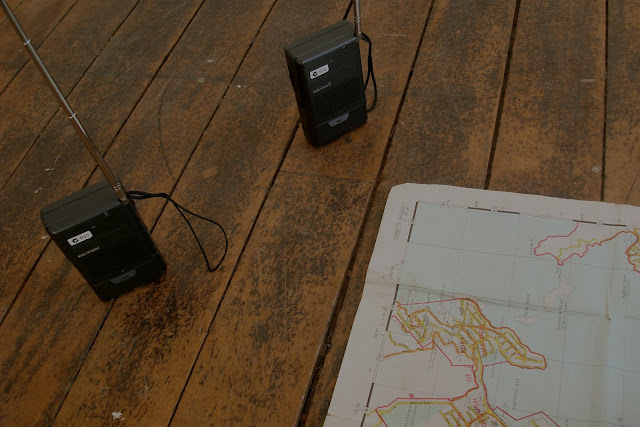
I kept recording while setting up for the show, unfolding an out of date municipal map of Dunedin and surrounding districts and placing this on the beautiful bare wood of the gallery floorboards. I knelt on this map, after removing my shoes, and slowly surrounded myself with an infrastructure of radio receivers. This radiophonic cityscape was tuned progressively into the field recording I had just made, which became audible alongside the usual mini FM residue of etheric bleed and chaneling-into-audibility of the airwaves of the space itself, a soundscape occasionally layered at points with recordings of solo violin done in the previous month.

The sound was transmitted to the space using a solar panel connected to my Mini FM transmitter, the latter in this way directly powered by the strong white winter New Zealand light streaming through the gallery windows. At a certain point near the concluding stages of the hour, an analogue vocal mapping of street and place names, read aloud as-written on the grounded map, supplemented the transmission, further scoring a body-sized poetics of place live to the gallery space.

As a compositional framework, this live site-specific transmission, or radio show, was bolstered by the additive improvisational accompaniment of Motoko Kikkawa on violin and amplified chip packet, as well as Matthew Ward and Richard Scowen on various instruments.

how to explain radio to a dead huia


“This is where we must begin; with the magical power of replication, the image affecting what it is an image of, wherein the representation shares in or takes power from the represented — testimony to the power of the mimetic faculty through whose awakening we might not so much understand that shadow science known as magic… but see anew the spell of the natural where the reproduction of life merges with the recapture of the soul”
— Michael Taussig, Mimesis and Alterity

‎"In the midst of beings as a whole an open place occurs. There is a clearing, a lighting... Only this clearing grants and guarantees to us humans a passage to those beings that we ourselves are not, and access to the being that we ourselves are."
— Martin Heidegger, Poetry, Language, Thought

on the afternoon of Friday February 11, 2011, radio cegeste transmitted a Mini FM radio programme within Orokonui Ecosanctuary, a 307 hectare regenerating forest ecosystem located just outside Dunedin in New Zealand's South Island.

this transmission - an experimental, site-specific nature documentary - involved gathering location recordings of birdsong and ambient sound in the sanctuary during the morning, these sound files being re-transmitted the same afternoon in a natural clearing, demarcated by three giant Rimu trees, deep within the forest. 17 small radios were hung in this clearing; most in trees and others placed on the surrounding ground, these then picked up the signal from a mini FM transmitter, layering the recordings back into the space.

the show was about an hour in length and without human listeners, apart from the crew (one visual documenter, as well as myself; in fact as an aside i was thinking while sorting through the photos here showing the process of making the radio station, just how satisfying it was to engage with the notion of the implication of human presence within the bounds of its invisibility in the narrative of the traditional nature documentary).

the re-transmitted birdsong emanating from this 'flock' of decentralised small radio receivers filled the clearing and augmented and interfered with its sound, ultimately attracting many endemic birds. particularly distinguished guests were two large endangered kaka (nestor meridionalis), as well as many smaller birds which in more populated times would have often travelled together in multi-species flocks, including piwakawaka (fantail/rhipidura fuliginosa), some miromiro (tomtit/petroica macrocephala), pipipi (brown creeper/mohua novaeseelandiae) and titpounamu (rifleman/acanthisitta chloris) - the latter New Zealand’s smallest bird.

exploring the relationship between birds and radios has become somewhat of an ongoing, extended multi-layered research project for radio cegeste, with this programme the continuation of a line of thinking (or flight?) taking the materiality of radio waves, a focus on the territorial delimitation of mini FM, the traditions of the natural history museum and the birdsong as a NZ cultural sonic trope into various site specific territories and exploratory notions around 'environmental radio'. this work in progress will continue with future iterations under the general programming title of radio d'oiseaux, in part-homage to composer Olivier Messiaen.

the radio d'oiseaux project asks some broad questions about the relationship of the museum to the living world it catalogues, progressing with the assumption that the modernist natural history museum, with its mounted specimens in vitrines, is in some sense the shadow other to the national park, or ecosanctuary, the latter being a more contemporary conception of 'natural heritage', or a 'living museum', albeit with a related focus around the notion of the archival preservation of species as museological. as a sound project, radio d'oiseaux is also interested in the materiality of the sonic object and the functioning of sound recording as a form of memorial museology, and the fact that the impulse toward field recording of birdsong has, in new zealand, historically found a home on the radio, and within the audible texts of national identity.


this particular iteration of the project also trucks with the notion of documentation being the only trace of performance, and asks whether (and if so : how), the deliberate non-spectatorship of an event in an overmediated world can lend clarity to that event, and, relatedly, that if we posit that there is no such thing as an event without an audience (or a tree falling in a forest, or silence, variously), what might happen if we imagine a spectatorial base that is non-human, or "natural". how can we approach non human animals, in other words, as listeners that are "equal but differ
ent", and what might this mean? what is it to understand a non human species, to approach an encounter outside any propensity to anthropomorphise, to get around 'figurative appropriation' - using animals as symbolic, reductive, sentimentalised, illustrative metaphors - and can we
make steps to do this by tracing observations about the history and development of the human-nonhuman animal bond? i.e. how does reciprocality function in this relationship - in a general situation, as Erica Fudge puts it, where “we lack a language at present in which we can think about and represent animals to ourselves as animals, in ways that are not metaphorical" (Fudge, E. (2002). Animal.)

a touchstone here is the event-work for which Fluxus artist Joseph Beuys is perhaps most famous, in which he claimed he preferred to explain pictures to a dead hare than to human, western, cultural, head-based beings, saying “A Hare comprehends more than many human beings with their stubborn rationalism ...I told him that he needed only to scan the picture to understand what is really important about it” (Jones, A. The Artist’s Body, p.77)

a delayed response to this statement might be found in an interview with the German artist Wolfgang Müller, talking about his 2009 project Séance Vocibus Avium, a book/record whose reconstructed sound-poetics of human imitations of extinct birds won its author the Karl Sczuka-Preis for radio play as radio art:

"Q : Your installation features drawings and the reconstructed sounds of extinct birds. What does the name mean?

A: Séance, you know, is from French, a spiritual meeting with dead people. Vocibus avium is ‘voice’ and ‘bird’ in Latin. It sounds like abracadabra: mystic and magical. Our society believes they are not mystical and not magical – that this is something exotic other countries have. They say we are very rationalistic, very serious, but I don’t think so. There are different descriptions of these bird sounds in every language: French, German, English. You cannot hear the original sound so only the different interpretations make the truth. The drawings work a bit like this too – similarities and differences. I thought it was a nice idea to get musicians and singers, including a Grand Dame of the National Icelandic Theatre, to reconstruct sounds of birds that were never tape-recorded. I wanted a natural record."


my piece's methodology was inspired somewhat variously by recent bioacoustic studies into bird listening and mimicry, notions of EVP and the perpetuance of ghost-signals via transmission, the potential for a radio station powered directly from the sun, how birdsong is affected by human changes in the soundscape, and some general wondering around how Deleuzian ideas about the birdsong as refrain and the sonification of territory relate to small scale, bounded radio transmission.

some specific formal elements were inspired by a story reported on the Radio New Zealand website on the 8th August 2009, under the header :
Birdsong recordings to lure kokako to new homes

"
Thirty rare native kokako are to be relocated in the North Island with recorded birdsongs being played to help them settle in.
The birds are being moved to help re-establish kokako populations in Whirinaki Forest Park near Murupara and in the Waitakere Ranges.
Waikato University PhD student David Bradley will use recordings made from the birds' home territory, including the Urewera National Park and forests in King Country and Waikato, to encourage them to stay in their new surroundings.
Mr Bradley says the pre-recorded birdsongs will be played through speakers that will be hoisted by ropes into trees."
many thanks are due to Ben Smith, Orokonui guide, and Campbell Walker, photographer.

the sirens have been remaindered


[cegeste sound library #1]


-----

quail island / the sirens have been remaindered


at the edges of whatever
can be attended to : ordinary
sky over

orderly macrocarpa : the lack
of perceptive
limit, over

this unwalled line of sea
stones, as
the ear : stacked

against the unending lack
of a word, or line
of words, is

the edge of whatever
can be languaged :
they are not (quite)

bricks, & the sky’s lending
library, full of wrecked
systems (persistent

repetition of cirrus
phrases : seeming to fan
out from something

prior, indecipherable),
admits its gaps
without arrogance,

shelves this eye’s
openness at mid-
air’s deaf

point : to browse,
half-Whitmanic,
half-shattered

along these introduced
avenues, in the green
exuberance

this gift is : its space
of not-knowing
is a mouth :

is, the misc.
silences (lengthened, as
breath) between

the noon shadows, the memes of
stated trees. but whose freedom
is it? it is a sky

i do not always know
what to do with (how to deal
with : as the ship’s

graveyard knows
implicitly : the quiet
rust into oblivion

within the day’s
greater attention,
as metal flakes

restate themselves
to the ocean’s
equal blood-taste)

-----

[track created 2nd August 2010. location recordings made June 2009, in the grounds of seacliff asylum, dunedin. violin scratch-drone recorded in dunedin in June 2009, edited in wellington August 2010. the poem 'quail island / the sirens have been remaindered', also written in the first week of August, 2010.]

[for janet frame. with thanks to edie stevens and markus gradwohl]

...installation at 'Ringworm' open home Christmas show, Wellington


Wellington based curator Melanie Oliver organised a small group show in her house, a big multi-person flat on a hill whose windows overlook the sea and the wide horizon, which are both such iconic features of that cityscape, as an open home Christmas exhibition. When radio cegeste was invited to participate, I gathered some location recordings from around the long meandering stretch of the Wellington waterfront, and broadcast the sounds of the ocean on the day of the show to the radio used domestically within the house (in the kitchen), as well as a small transistor I placed in the bathroom.


many thanks to Ann Shelton for the wave-cactus-transmitter photo, and to Melanie Oliver for the others. Melanie archived the show on her blog for posterity here

environmental radio : radio d' Oiseaux


radio d'Oiseaux is a solar powered radio station for New Zealand native birds. Currently a fieldwork project, it will eventually manifest as series of radio cegeste site specific performances.

as an "environmental radio" and conceptual media project, radio d'Oiseaux looks at the links between transmission, locality and territory.

as a sound-site, the birdsong is a place of trauma and nostalgia in NZ, a situation helped along by its long association with public broadcasting. the public outcry a few years back at the intended removal of field recordings of native avian species, long a temporal marker for news reports on Radio New Zealand National, provided weighty evidence of its cultural place. The presence of bridsong as ‘soundmark’ can be percieved as displaying a memorialising or museological function. To replay already-extant sound has its own embedded politic - the loop itself is a ‘territorialised’ refrain in Deleuze’s terminology – here, Radio New Zealand's treatment of the sounds of birds is a paradigm reiterated in cultural terms by the replay of songs sent to radio stations by record companies. Instead, to deteritorialise this medium’s approach to art, we might learn from talking to the animals.

--

“the plan was to put microphones in remote locations uninhabited by humans and to broadcast whatever might be happening out there; the sounds of wind and rain, the cries of birds and animals – all the uneventful events of the natural soundscape transmitted without editing into the hearts of the cities. It seemed to us that since man has been pumping his affairs into the natural soundscape, a little natural wisdom might be a useful antidote”.

“An excess of environmental noise produces sloppy listeners. We no longer listen to the radio, we overhear it. It stays on, shielding us from the coarseness of modern life. Radio has become the birdsong of the twentieth century, decorating the environment with “pretty””

- R. Murray Schafer